
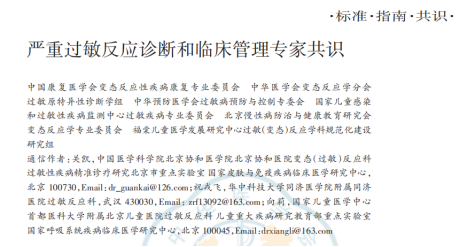
Key Points of the Expert Consensus on the Diagnosis and Clinical Management of Severe Allergic Reactions (2025 Edition)
I. Definition
Severe allergic reaction is a rapid-onset, life-threatening hypersensitivity reaction involving multiple systemic organs, mostly accompanied by cutaneous manifestations. A minority of cases present with only isolated respiratory or cardiovascular symptoms and signs. The immunological mechanism is predominantly IgE-mediated, with a small number of cases attributed to non-IgE-mediated or mixed mechanisms.
II. Pathogenesis
The IgE-mediated pathway is the most common and classic mechanism.
III. Triggers
Food: The most common trigger in children, with age specificity. Cow's milk, egg and wheat are the most common triggers in infants and young children; fruits/vegetables, buckwheat and nuts are common in preschool and school-age children; wheat and fruits/vegetables are prevalent in adolescents and adults.
Medications: The most common trigger in adults and hospitalized patients. In China, the most frequent sensitizing medications include antibiotics, traditional Chinese medicines, contrast media and antineoplastic drugs.
Insect stings: Mainly caused by Hymenoptera such as honeybees, wasps and hornets, as well as invasive species like fire ants. This trigger is more common in adults than in children and is prone to induce severe anaphylaxis.
Idiopathic: Severe allergic reactions with unidentified triggers are defined as idiopathic severe allergic reactions, and some patients have abnormal mast cell activation.
IV. Precipitating Factors
Common precipitating factors include exercise, acute infection, non-steroidal anti-inflammatory drugs (NSAIDs) and alcohol consumption. Other factors such as mental stress, sleep deprivation, dehydration and menstrual cycle may also exacerbate the symptoms of severe allergic reactions.
V. High-Risk Populations
High-risk populations include: atopic individuals, patients with underlying cardiopulmonary diseases (e.g., cardiovascular diseases, asthma), those with mast cell activation disorders, individuals at specific age stages (infants, the elderly), and patients taking β-blockers or angiotensin-converting enzyme inhibitors (ACEIs).
VI. Clinical Manifestations and Disease Course
1. Clinical Symptoms
Mucocutaneous symptoms and signs are the most common, which may be accompanied by respiratory, gastrointestinal, cardiovascular and neurological symptoms simultaneously. Symptoms are associated with triggers, underlying diseases, age and other factors. Cardiovascular involvement is more common in medication-induced severe allergic reactions, and symptoms in infants are sometimes difficult to identify due to age characteristics.
2. Disease Course
It can present as monophasic, biphasic, persistent or refractory.
VII. Laboratory Examinations
1. Tryptase Test
Recommended for the diagnosis of severe allergic reactions, especially in patients with recurrent severe episodes or unidentified triggers.
2. Allergen Testing
Mainly applicable for IgE-mediated severe allergic reactions. Serum specific IgE (sIgE) testing can be used for the detection of food, inhalant, bee venom and medication (e.g., antibiotics, chemotherapeutic drugs) allergens. At present, commercially available sIgE detection reagents in China are mainly used for the detection of some food and inhalant allergens, with relatively few reagents for medication and venom sIgE testing. When commercial reagents are unavailable or sIgE results are inconsistent with medical history, allergen component-resolved diagnosis and skin tests can be considered as supplementary examinations. The specificity and sensitivity of skin tests vary with different allergens; a negative skin test cannot rule out allergy, and test results need to be interpreted in combination with medical history. Skin tests are usually negative in severe allergic reactions caused by cytokine responses and complement activation.
3. Allergen Challenge Test
Challenge tests can be performed under medical supervision when allergen testing fails to identify the trigger. Since challenge tests themselves may induce severe allergic reactions again, the operating physician must carefully evaluate the operational risks and the subject's benefits, and conduct the test cautiously after obtaining the informed consent of the patient or caregiver in full.
VIII. Diagnosis
The main basis for the clinical diagnosis of severe allergic reaction is a detailed attack history, including symptoms and signs, as well as a history of exposure to known or suspected allergens and precipitating factors. Clinical Diagnostic Criteria: A diagnosis of severe allergic reaction is highly probable if either of the following conditions is met: (1) Typical cutaneous manifestations accompanied by at least one manifestation in other systems (e.g., respiratory, cardiovascular, gastrointestinal systems); (2) The occurrence of respiratory and/or cardiovascular symptoms after exposure to known or suspected allergens, with a minority of cases lacking typical mucocutaneous symptoms.
IX. Treatment
Epinephrine is the first-line emergency medication for severe allergic reactions and should be administered intramuscularly upon diagnosis or strong suspicion of severe allergic reaction. Use a 1:1000 epinephrine solution (1mg/mL): the dose is 0.5mg per administration for adolescents and adults; for infants and children (≤12 years old), the dose can be calculated by body weight at 0.01mg/kg, with a maximum single dose of 0.3mg. There is no absolute contraindication to epinephrine in infants and children. Corticosteroids and antihistamines are second-line therapeutic agents and cannot replace epinephrine.
A small number of patients with severe allergic reactions do not respond to the initial treatment of intramuscular epinephrine, intravenous fluid resuscitation and second-line drug therapy, and should be immediately referred to the emergency department or intensive care unit for treatment. Patients with hypotension or shock who have a poor response to basic treatments including intravenous fluid resuscitation require continuous intravenous infusion of epinephrine. Continuous intravenous epinephrine infusion carries the risk of potentially fatal arrhythmias and must be administered via an infusion pump, with close monitoring of blood pressure, heart rate and other indicators, and operated by experienced medical staff.
Special Populations
(1) Pregnancy: Most management measures are the same as those for non-pregnant individuals, and epinephrine therapy remains the primary intervention. The differences from non-pregnancy management are as follows:
① Position: Place the patient in the left lateral decubitus position to avoid compression of the aorta and vena cava by the gravid uterus.
② Maintain the maternal systolic blood pressure at above 90mmHg (1mmHg=0.133 kPa) at a minimum to ensure adequate uterine and placental perfusion.
③ Monitor the fetal heart rate when necessary to assess the fetal status after maternal treatment.
(2) Infants: There is no absolute contraindication to epinephrine in the treatment of severe allergic reactions in infants. Delayed administration of epinephrine increases the risk of death.
(3) Patients with cardiovascular diseases: There is no absolute contraindication to epinephrine in patients with cardiovascular diseases, but the benefits and risks must be weighed. Severe adverse reactions (including ventricular arrhythmias and hypertension) are more likely to occur after intravenous injection than intramuscular injection of epinephrine. Therefore, intramuscular injection is recommended as the first choice, and the initial dose can be reduced as appropriate, especially for patients in the acute phase or with unstable conditions. Continuous monitoring of electrocardiogram, blood pressure and heart rate is required during treatment, with vigilance for arrhythmias or blood pressure fluctuations.
X. Prevention and Management
Undergo specialist consultation for allergic reactions to identify allergens or triggers and prevent recurrence.
Formulate personalized written documents to inform patients or their guardians of the pre-hospital management plan.
Allergen immunotherapy (AIT) is indicated for severe allergic reactions induced by food, insect stings and medications [including chemotherapeutic drugs, monoclonal antibodies (mAbs) and antibiotics], and is mainly applicable for IgE-mediated severe allergic reactions; it is also suitable for some cases of severe allergic reactions mediated by cytokine responses and mixed mechanisms. When the allergenic medication is essential for the treatment of an underlying disease, drug desensitization therapy should be considered.
Biological agent therapy: Biological agents have shown certain potential in the prevention of severe allergic reactions, but large-sample clinical studies are urgently needed to confirm their safety and efficacy, especially the long-term efficacy.





About Us
Product Center
News Center
Application Scenarios
Contact Us
COPYRIGHT 2025 Coninno Biotechnology All rights reserved 苏ICP备2025158326号-1
Content for medical professionals only, not for the public. Not medical advice. Follow product instructions for clinical use.

 Back to Previous Page